Return to the official Bandelier website...
Blog Sponsored by the Friends of Bandelier
Visit our website...


Thursday, October 31, 2013

Come Flames Or High Water


Historic orchard in Frijoles Canyon
The storm was freakish. In just a few days, eight inches of rain had fallen in Bandelier National Monument. This was extraordinary for a landscape that begs for 16 inches of precipitation annually. But unusual has become the norm for Bandelier. In just more than a decade, summer temperatures have gotten hotter, precipitation has declined, fires are bigger and floods devastating.

Evidence of change can be seen throughout the monument. Pinon pines, killed by drought, stand lifeless on the mesa, charred trees blackened by fire topple in the wind, and creeks churn thick with ash and mud during summer storms. We, the stewards of Bandelier, have come to expect the unexpected and learn to live with a new geography. We prepare, as best we know how, to deal with disaster.


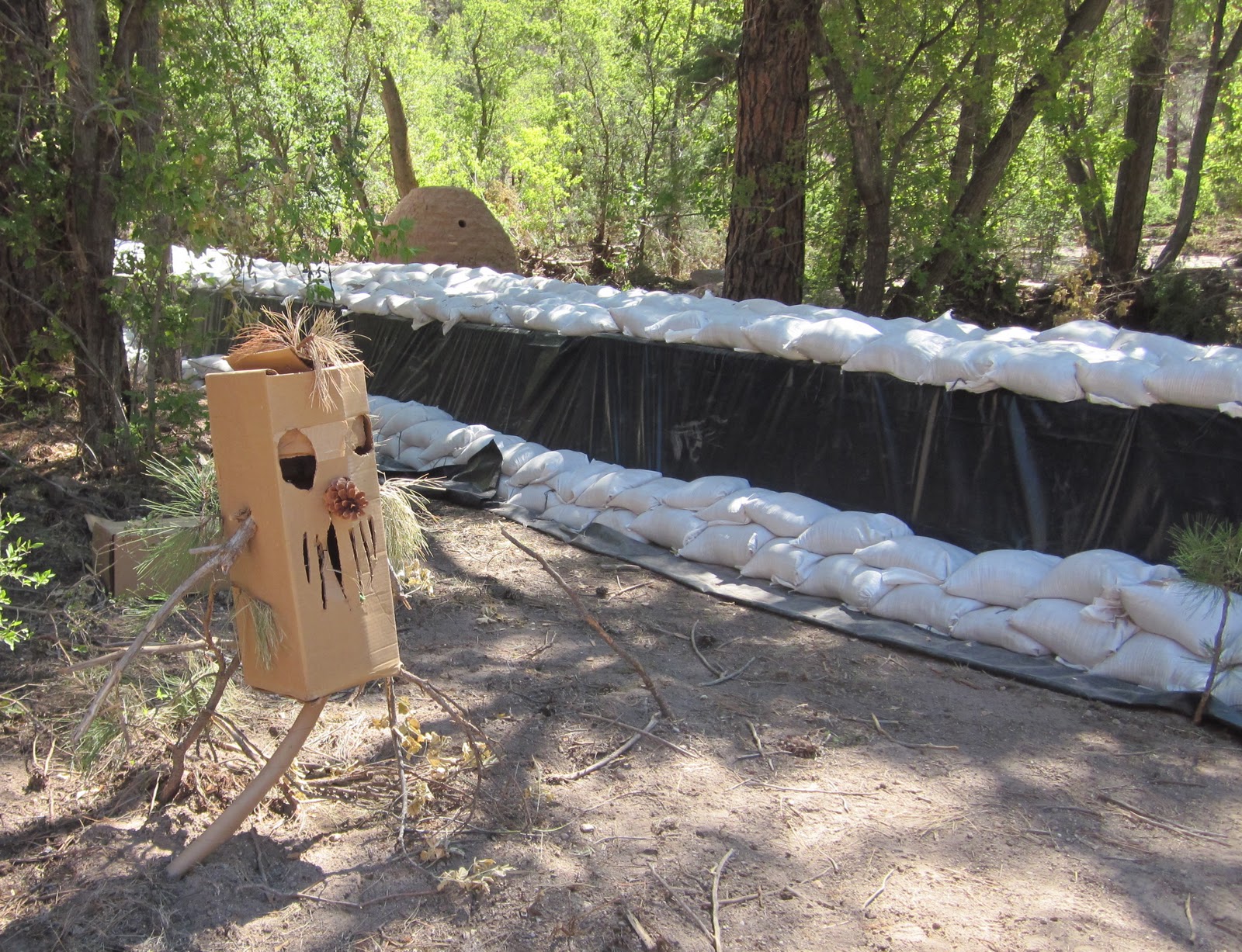
Thirty thousand sandbags are propped on the cement barriers, creek-side, in the historic district of Bandelier National Monument. The sandbags were put in place in 2011, just after the Las Conchas Fire roared over two thirds of Bandelier National Monument. Sandbags are not typically what you would expect to find in a national park. Most parks are beautiful. We come to witness the sublime. Sandbags are not pretty, nor are they sublime, but perhaps in this era of changing climate, it is time to re-calibrate our expectations and even our notion of beauty. 

Charred forest
It was 4:20 in the afternoon, on September 12, when I received the call from Ranger Ryan at the visitor center, “We expect high water to arrive within a half hour.”  Ryan was accurate. Within 30 minutes water burst over the banks of Little Bean Creek creating a current too swift to safely traverse.  Visitors had been informed to stay away from and not cross the creek. Stranded, two noncompliant men shivered in the rain, waiting helplessly, on the far side of the creek, for the current to subside, before crossing to safety. Was it a sense of adventure that led them to cross?

Since the fire in 2011, two significant flooding events have occurred in Frijoles Canyon, the first happened two months after the fire, the second onslaught of water came in July of this year. The third was imminent. More rain was predicted overnight and into tomorrow.

Picnic area
At approximately 8:30 am, the following morning, on Friday, September 13th, an unprecedented surge of water roared down frijoles canyon, tossing boulders, uprooting trees, lifting picnic tables, busting steel cables, tossing sand bags in a frothy mess of ash and mud at a speed of 9000cubic feet per second, leaving a mud line at 13’ above the canyon floor, leaving us wondering if this is the new normal? 
After several days of cleaning up and re-routing trails, post flood, Bandelier re-opened for business. We have become an outdoor laboratory for anyone curious about the effects of fire and flood in a dynamic landscape.
Trail to Alcove House
We continue to be awed by the power of water as we scramble up, over and around boulders and haystacks of trees piled high when exploring the upper regions of Frijoles Canyon. We don’t wonder if this will happen again, we just figure it will and we will do our best to be prepared. We have adjusted to the unfamiliar and changing face of Bandelier.


Sticks
Stones
Fire and flood are not uncommon ecological events. Ecosystems like the one at Bandelier are meant to burn, lightly, every five to ten years. In doing so, nutrients return to the soil and the density of trees and ground fuel remain low. But we have tampered with nature and created conditions conducive for massive, hot, crown fires.

Until relatively recently, and perhaps too late, land managers believed forest fires were detrimental and should be extinguished as soon as possible. This policy of fire suppression created unnaturally dense forests. Fuel laden landscapes combined with our contribution to a changing climate has led to a rise in high intensity, high acreage fires. Bandelier’s forest and streams are heir to this legacy. 


Visitors to Bandelier often ask if any lives were lost in the fires. Yes. Vegetation, animals and insects perish with every forest fire and subsequent flood. No fish or aquatic invertebrates are left in the park streams following the floods. In many parts of the park there is now much less food and shelter for the animals that did survive.
Frijoles Creek
Sometimes events out of our control, ones that have nothing to do with fire or climate change, prevent visitation to Bandelier. On October 1, Bandelier was closed due to the government shutdown.We locked the doors and gate and walked away leaving patrol rangers as caretakers during the closure. As rangers and land managers we never truly walk away from a place that we love and love to share with others. Like the visitors who come to the park each autumn, we were anxious to return to this changed but beautiful place we call Bandelier.
Long House
On October 17, the government re-opened. In the warmth of the brilliant October sun I greeted visitors back to Bandelier National Monument. Many extended the same warm welcome to me. Come flames or high water Bandelier is here for you.

Nature Trail


Thursday, October 4, 2012

The Outdoor Classroom


Each of us can name a defining moment or event that has shaped our lives. I was eleven years old, soon to complete the sixth grade, unaware how the morning would impact my life. It was the time of year when the tender leaves of oaks unfurl chartreuse against the backdrop of blue sky. Later, I would refer to this as the time of warblers.

In the sunlight of a May morning, our sixth-grade class walked single file onto the yellow bus that would transport us to the Watchung Nature Center. At the center, staff naturalists efficiently divided our class into two groups before leading us into the wild heart of nature. For half the morning, half the class would learn about insects, while other half studied birds.

As instructed, I held up the hand lens to the face of a fly and stared lock-eyed with what appeared to be a thousand eyes. This was my first close-up encounter with a creature that had nearly 360 degrees of vision. No wonder flies were impossible to swat! Soon after my encounter with the compound eye, I was equipped with a bug box and net. I rustled the grass and shrubs to find butterflies, beetles, crickets, grasshoppers, cicadas, leafhoppers, and ants. My world was filled with the six-legged critters that flew, crawled, and chomped away at everything green.

Although my morning with the insects was fascinating—certainly better than any bookish lesson in a stuffy classroom—it could not compare to the thrill of birds. For the first time in my life, I was handed a pair of binoculars and instructed to spot the singers. The naturalist explained how each bird was specifically adapted to its habitat and how the shape of the bill was a clue to where the bird lives and what it eats. We learned that conical-shaped bills belonged to seedeaters and thin bills to those that picked bugs from under bark. We observed yellow-rump and black and white warblers flitting high in the oak canopy, busily picking insects off leaves and twigs with their slender bills, as mourning doves cooed from woody perches and red-tailed hawks let their voices tumble in shrieks from the sky above. We spotted a mother robin sitting on a clutch of blue eggs in a nest made of dried grass and mud. Below her, a rufous-sided towhee scratched in the duff for insects. Blue jays and cardinals called from the thicket as I fell under the spell of birdsong and color.

That evening, I asked my father for a pair of binoculars. I was hooked. I have been birding either professionally or for enjoyment ever since. Often I think back on how lucky I was to have that special morning at the nature center.

Last week I participated in another exceptional morning. I arrived at the Bandelier National Monument bird banding station at about 9 a.m. Wildlife biologist Steve Fettig and his Latin American interns, Diego and Pilar, had been monitoring the nets since sunrise. Steve held a ruby-crowned kinglet in his hand, carefully banding, aging, and weighing the diminutive migrant.
  
For nine years, Steve has been operating the banding station in conjunction with the Park Flight Migratory Bird Program.  The program works to protect shared migratory bird species and their habitats in both U.S. and Latin American national parks. The data Steve collects provides information on how the birds use the diverse habitats of northern New Mexico.

As part of the program, local school children visit the station to gain firsthand knowledge of animal-habitat relationships. The kids engage in activities highlighting species diversity and adaptation.  

At 9:30 a.m., thirteen sixth graders arrived. Beth, a naturalist from the Pajarito Environmental Education Center, greeted the students. Since the group was small, Beth and I would work together with the children. After a mist net demonstration, we led the class into the forest to see it was able to support the bird species that each child had chosen as his or her “identity” for the morning.

This chilly morning in the Jemez Mountains would become a defining experience for many of these children, shaping lives that cared about the natural world, a world where science matters. At the banding table, we watched as thin metal bands were painlessly clamped onto the delicate legs of juncos, siskins, and warblers. Each child was eager be chosen as the one to release the captive bird back into the wild. Faces were bright with awe as feathered life was placed into the palm of the lucky child.

Two boys, Jack and Will, vastly different in their demeanor, remained at the station with their mothers, after the rest of the class departed. I heard Jack asking Steve how could he learn more about the birds in the area. Will remained silent as he raised his binoculars and scoped every tree and shrub for birds. These youngsters were hooked.


Tuesday, July 24, 2012

High Water

High Water July 11, 2012
In many ways this seems like a typical summer: a skink scurries across the trail taking refuge in last year’s fallen leaves, Cooper’s Hawks raise their young, along the creek, in an old cottonwood tree, Turkey Vultures stretch their wings in the warmth of the morning sun and each day I guide visitors into heart  the of Frijoles Canyon. We walk the path of the Ancestral Puebloans, peer into kivas, hike through Tyuonyi village and climb high into cavates. Together we watch sunlight slide across the south-facing cliff and the afternoon thunderheads build.

It is monsoon season in a land scarred by fire. It has been one year since the Las Conchas Fire blazed more than twentythousand acres of Bandelier National Monument. To the casual visitor this means little. Mostly, the evidence of the burn remains out of view. For the individual venturing into the backcountry the experience is different. Bare ground and ponderosa pine skeletons tell the tale of last year’s inferno. A story of a fire I would rather forget, but I can’t and don’t.

Every day, I witness activity related to the fallout of combustion. Where there is fire there is often flood. Without vegetation rooted into the soil the burned-out canyons can't hold back the rain. Last August the creek swell scoured lichen from rocks, and logs, vegetative debris and boulders tumbled down the trail, wrapping and resting in heaps around tree trunks, leaving our parking lot filled with muddied ash. This summer we expect the same. When the sky darkens we wonder, “Will it flood today?”

Last week the creek rose high enough, with a current strong enough, to wash away footbridges and leave us wondering when high water will come again.

This afternoon I hear the sky rumble and watch fast-moving clouds. The park radio crackles, I hear the voice of our chief ranger, “Bandelier employees Bandelier employees, I know you are concerned, but the big cell has passed. It is to the south and we have received little rain in the upper watershed.” I relax. The Visitor Center is safe for now.

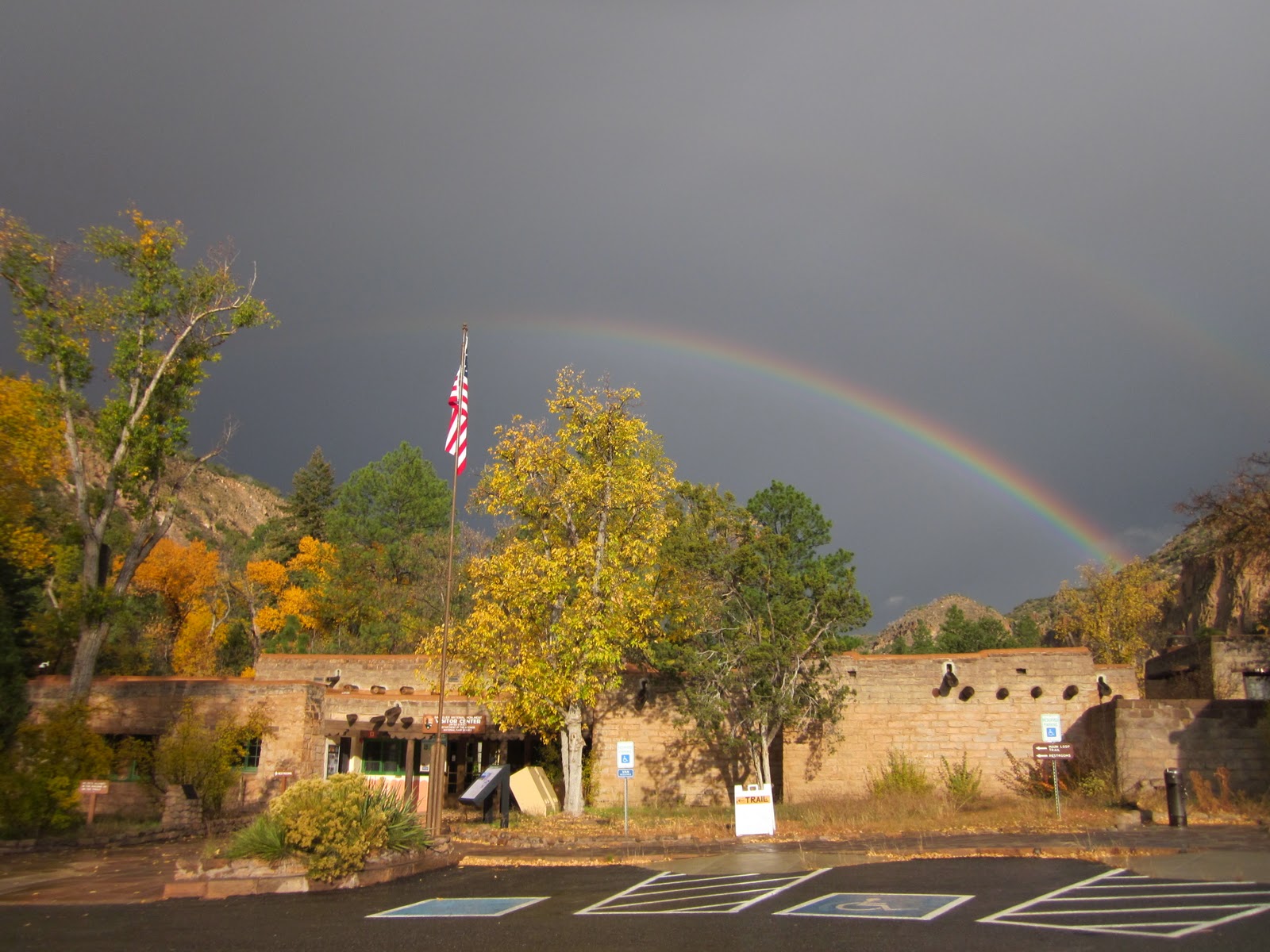
Thousands of sandbags and concrete barriers are positioned to divert high water away from our historic Visitor Center. Last year the barriers were successful in protecting the structure. This year we hope for the same good fortune.

Admittedly, the flood protection and last year’s jumble of flood debris flanking the creek appear a bit odd in this landscape of undiminished beauty. The coyote who routinely uses the trail to hunt for mice and  the fawn strechting her wobbly legs pay little attention to concrete and sand. Yet each sandbag serves as a reminder to walk alert, listening for the sound of a rising creek, while knowing there is refuge on higher ground.


Friday, January 6, 2012

Wash Out

Hope
 “The trail is washed out.”  Those were the last words I heard out of Elliot’s mouth before closing the visitor center door.  I zip my jacket, nod to the folks getting out of the RV with Maine plates and walk across footbridge to the Falls trailhead, whispering under my breath, "It's ok, this is no big deal.” A mantra, my pep talk recited daily before heading onto the path. Elliot’s words echo through my head, “The trail is washed out, the trail is washed out…. fire, flood”. It is difficult to escape the changes to the Bandelier landscape post Las Conchas Fire.

It is late November just after Thanksgiving, the weather is mild and dry. A tardy flock of Sandhill cranes flies overhead on their route south to wintering grounds. It is late for crane migration. Nothing seems normal, not the birds, not the land.

the fallen
A winter flock surrounds me. Titmice flit and dart from under the cover of orange leaves clinging to the branches of gambel oak. The flock grows larger with the addition of juncos diligently seeking food in the vegetation along the creek. I stop and watch. My view is unobstructed. I am standing along the first hundred yards of the Falls Trail. The birds, unconcerned by my presence continue their frenetic business of finding seeds to keep them fat in winter.  What I see is odd, birds standing on prostrate trunks of alder, river birch and boxelder. Life along the creek has become horizontal.

I respond, daily, to the inquiries of puzzled visitors asking, what happened here?” “It looks like a flood came through here” When did you have a flood? How high did the water rise? Can we get to the river?
washed out trail
I reply with unpleasant truth, “No you can’t get to the river. The trail is undercut below the second falls. It is about to cleave away. No, it won’t be rebuilt, there is nowhere to construct a new route”. The same questions and the same answers spill from my from my mouth again and again in response to the curious that come to visit Frijoles Canyon since reopening in the first days of October.

sandbags and barriers
Yes, it was a flood. The water came roaring down the canyon on August 21, the day the monsoons dropped three inches of rain in twenty-five minutes. A noticeable water line on tree trunks is visible amid a tangle of broken branches, cracked limbs and leaves littered along the creek, like confetti from a ticker tape parade.

The signs of the flood are everywhere.  There is nothing to hold back the water. Most all of Frijoles Canyon, with exception of the last three miles, is severely burned. Jersey barriers and twenty thousand sand bags are strategically placed to protect the recently renovated visitor center. The back breaking attempt at flood mitigation succeeded with the exception of a few snapped steel cables linking barriers, knocked wildly to their sides, in the fury of a frothy mixture of ash and water carrying sandbags on a high tide to the banks of the Rio Grande two and a half miles downstream.
sticks and stone, mud and ash
What will happen next summer when the monsoon rains return? The thought is dizzying. I leave the juncos.  A curve in the trail reveals gray naked mounds; boulders scoured clean of lichen, once discretely hidden amid thickets of New Mexico olive and chokecherry, shimmer in the New Mexico sun. Behind me canyon walls are cloaked in mud stretching upward 15 feet.
debris littering the trail
 I place one foot in front of the other and continue my disoriented walk in a once familiar landscape.

Monday, July 18, 2011

Contemplating Fire


It is the third time in four days that a single raindrop has fallen on my skin, a reminder of why I am here, sitting in the shade of a living ponderosa pine, in the Jemez Mountains in Bandelier National Monument. I am a lookout, a sky watcher, secretly praying for rain in a landscape of dried grass and shriveled flowers. This land is dusty, dry, parched, splitting at the seams, splattered black with ashen trunks and scorched limbs.  I wonder what on earth is providing sustenance for hummingbirds? The air is thick, acrid and stings my lungs with each life giving breath. What movie-set have I stumbled onto? I want rain.  

The ponderosa pine providing my comfort has a laminated 8 1/2 by 11 sign stapled to its bark. The irony of the message stands out like bold letters printed on a huge signboard, “Area Closed” Due to extreme fire danger. All Bandelier trails and backcountry are closed to entry. Effective 8:00 am June24th.”

The morning the sign was posted  I hiked to the top of Cerro Grande, making sure people were compliant with the message. They were. People stayed away, keeping the forest safe from accidental ignition. The closure would be lifted when monsoons arrivedBriefly refraining from hiking in the tinderbox landscape was a relatively minor inconvenience compared to the major inconvenience of inadvertently introducing catastrophic fire to this already stressed ecosystem.  

In the weeks before the closure, I hiked in steeped walled canyons, along broad mesas, up peaks and across meadows in Bandelier National Monument.  With each twist in the trail and open vista, I became reacquainted with a landscape first introduced to me on a cross-country road trip many years ago.
It was back then that I thumbed the pages of a tattered southwest hiking guide and stumbled upon a place called Bandelier National Monument. The hiking sounded good and I was eager to explore.

I fell in love with the landscape of Bandelier on that first visit. The afternoon of my arrival I hiked out of Frijoles Canyon and roamed the mesa top until I reached the breath of a canyon called Alamo. I sat under a large pinon tree, along the edge of the canyon, devouring pine seeds. It was a banner year for pinon seed production. I got my fill. Someday I will return, I mused, my eyes bathed in a palette of sienna, pink, ochre, buckskin, green and blue shading the canyon, sky, mesa and mountains.

In August of 1997, I returned to Bandelier and stayed, my love affair with color, light and beauty continues fourteen years later and strengthens with each step placed upon this land. I share my passion for this sacred ground while giving tours and programs, as an interpretive ranger, to countless people from all over the world.

Over the years, I have observed the changing climate and landscape of Bandelier.  In the first summer of my arrival rain fell, the verdant land became irresistible to those who sip nectar. Broadtailed and black-chinned hummingbirds zipped from blossom to blossom lapping up sweetness. In subsequent years, summers arrived with record-breaking heat and diminished rainfall.

Weather graphs illustrate the hottest and driest summers on record and winters lacking significant snowfall. Pinon and ponderosa pines fail without moisture. Native bark and twig beetles thrive on the weakened trees eating away what little life is left.  Only pinon skeletons remain, leaving juniper to shoulder the burden of green in a land of terra cotta cliffs.

I grieve the loss of the pines and pinon jays that followed suit.  Intellectually, I know weather patterns cycle, climates change and land rebounds. But this cycle is different, its scope broader, its effect strengthened by the impact of our behavior. I am in-part responsible for the loss of that which I love. This is a lot to ponder.

I continue to watch the sky. Through the haze of smoke, I see expanding blue.  The threat of rain recedes with the afternoon. I am stationed at the headwaters of Frijoles Creek ready to alert workers, in the canyon near Headquarters, of precipitation. I take my post seriously.  The Visitor Center and Frijoles Canyon has been closed to the public for three weeks.  Rain has become a threat.

A small storm can drop enough moisture to cause a flash flood. There is nothing to hold back the water. The land above headquarters is charred. There is no vegetation to keep the soil in place. Rainfall will bring logs and mud and ash slurry of crashing down Frijoles Creek in the wake of the Las Conchas Fire. On the blustery afternoon of June 26th. at approximately one o’clock, a tree fell on a powerline near a private ranch in the Jemez Mountains along state road  igniting a blaze, exploding into a funnel of wind and flames, blasting upwards and out, rapidly devouring all in its path.

On Sunday, June 26th, I shared a lazy day with a friend in Santa Fe. At 3 pm we stepped out of the house, our arms laden with sliced watermelon and cold beverages, treats to share at an afternoon party. “Hey I think the Pacheco Canyon fire blew up, the air is so smoky.” It took a few moments to get our bearings and realize this fire was new. This fire was different. My friend exclaimed, “ I think Bandelier is on fire.” “No, I think it is a bit west of the Monument” “Are you sure?  I think we should drive up and get your things.” I live, or should I say lived in the historic district of Frijoles Canyon near Park Headquarters. “No I don’t think we need to drive up. Someone from the Park will call if there is a problem.” Two and a half hours later I got that call. “Have you heard, we are officially evacuated.”  “What?”

That evening some friends and I grabbed a few important things from my cabin. It was not until we were driving out of the Park did I see the gravity of the situation. Orange flames mixed with a black and purple sky. Already bruised I thought. Maybe an hour or two before headquarters is gone. ”This is crazy. Lets get out of here.” It was hard to sleep that night wondering how life would be changed in the morning. Two of my co-workers had already lost their homes that afternoon to the fast and furious fire that would become the largest in New Mexico history. How much of Bandelier would be gone by sunrise?

When all was done, over 20,000 acres of Bandelier’s 33,000 acres were affected by the Las Conchas Fire. Some areas scorched to mineral soil and other areas lightly burned. Owing to the heroic efforts of Bandelier’s firefighters, the historic district stands, but not without threat.

Three out of fifteen miles of Frijoles Canyon, not consumed by flames, is now vulnerable to flash floods. A week after the fire ignited a decision was made to close the historic district. Bandelier employees were ousted from their offices and for others, like me, their homes; ousted from the canyon we love. Bridges have been removed, barriers and sand bags have been placed; Headquarters is at the mercy of rain.  I sit patiently waiting for rain to return this brown land back to green.

Full length:
http://www.youtube.com/watch?v=mju9oYwI36c&feature=youtu.be

closeup of the vortex:
http://www.youtube.com/watch?v=MMJOeVF7eQg

Monday, April 18, 2011

Spring Comes to Frijoles Canyon

It is Spring in Frijoles Canyon. Canyon Towhees are feeding their young nestled snug in a nest outside the office and countless other avian pairs are building homes and laying eggs. The canyon is full of life. Narrowleaf Cottonwoods have burst their buds offering a shade of green heralding the season. It is time to be awake, to be alive, time to arise from slumber.

This morning on my guided hike I nearly stepped on, but managed to barely step over, a large Bullsnake blending perfectly with winter grasses and autumn’s shed leaves. Perfect camouflage, I thought, as my heart pounded in my chest and as my eyes provided the visual information for my brain to fire neurons allowing my body to swiftly leap away from the snake. I needed a moment to determine that I was not about to step on a Western Diamondback rattlesnake. The harmless Bullsnake was the first snake I had seen this season. Safe, I continued with my program.

Snakes are not the only creatures to rise from their winter naps. For the fifth consecutive season the historic district of Frijoles Canyon has been home to a female black bear. Last spring the small shaggy blonde bear emerged from her winter lodging with two cubs. This year with a coat of cinnamon, momma and the cubs roam the canyon in search of delectable ants, tender shoots, buds, and roots to grow fat upon. As spring progresses the bears will add berries and acorns and possibly an apple or two from the old orchard to their menu. Omnivorous in their dining habits the bears would relish a dinner of dear meat if the opportunity arose. This type of meal occurs by being in the right place at the right time and having a little help from “friends.” Swift and stealthy mountain lions routinely stalk and take down deer in the Monument. A mountain lion will eat its fill and then bury or cache the leftovers for later. With an exceptional sense of smell, bears often find what the cat has left behind.

I delight in the opportunity to watch the bears from a safe distance. The bears, snakes, mountain lions and all the creatures of Frijoles Canyon are a reminder of how wonderful it is to roam within this protected landscape. This week is National Park Week. A time to celebrate our national treasures as we wake to the beauty of Spring.

Wednesday, March 16, 2011

The Pine Bough Mystery

Why are all these pine boughs on the ground? Are the trees losing their needles?  Virginia, a local resident, hikes the Falls Trail to the Rio Grande every Sunday. On her outings she began to notice the path littered with the branch tips of ponderosa pines and junipers. We stopped to chat about mid-way down the trail. I told Virginia she was not the first visitor curious about this phenomenon. All week long adults and kids alike have been asking for an explanation. The other common question I have been asked is, “What is that animal with long ears that hops like a rabbit?” The answer to the latter question directly relates to Virginia' mystery . The animal responsible for the litter and strange appearance is a squirrel. With a back of charcoal gray, a bottle brush tail and two inch long tassel ears, long rear paws and strong hind legs, the Abert’s squirrel is readily distinguished from other squirrels.


There are nine sub-species of the tassel-eared squirrels in the Southwest. Their range extends from the mountainous Ponderosa pine forests of New Mexico, Colorado, Utah, Arizona and parts of Wyoming and north central Mexico. Subspecies of Sciurus aberti can be determined by cranial size, body weight and coloration. For example, S. aberti ferreus living in the foothills of Boulder Colorado has a jet black body and a vivid black topped tail while the tassel eared squirrel residing along the North rim of the Grand canyon, S. aberti kaibabensis, sports a tail the color of snow.

The nutritious pine cambium is one of the Abert’s squirrel’s primary food sources. Each subspecies has adapted to eating the inner bark or cambium of the ponderosa in the region where they live, finding the terpene composition from other pine populations unpalatable. Abert’s squirrels also dine on the ponderosa seeds and buds. Ponderosa pines begin producing seeds at about sixteen years and continue producing viable seeds until they are 350 years old. Each cone will produce about seventy-five seeds with an average mature tree producing two hundred cones in a good year. A single squirrel can feast its way through as many as seventy-five cones in a day.

Abert’s squirrels are active year-round. In autumn excess pine seeds along with acorns and fungi are cached for winter. When the snows are deep, the tassel-eared squirrel will spend much of its time confined to the crowns of the mature pines gorging on the cambium and sleeping in pine twig nests. In winter, it is common to see the ends of pine boughs, nipped by hungry squirrels, littering the trail.   

Monday, February 28, 2011

Transitions

Greater Sandhill Cranes
It is that time of transition when winter begins to lose a tight grip, the weather warms, snow melts and woodpeckers drum frantically at dawn staking out their piece of turf. Spring is right around the corner. After a day of bluffing late season snow I welcome the intensity of sunshine under the blue vastness of the New Mexico sky. This morning, as I ascend the trail out of Frijoles Canyon to an archeological site on the rim, I am anxious to trade my winter uniform to the lighter weight of summer. With each switchback climbed I listen for any sound of spring announced by the voice of birds. The morning does not let me down. A sound, so familiar, tumbles from the sky into the depths, out of the mouths of Greater Sandhill Cranes, to the canyon below. Cranes wintering by the thousands in the middle and lower Rio Grande Valley of New Mexico have begun their northerly migration.Over the course of a few weeks the massive birds, with wings spanning greater than six feet, fly over the Monument in large formations and numbers, en route to their breeding grounds in Colorado, Idaho, Utah and Montana.

 In the Bandelier wilderness there is a large carving of a crane pecked into stone at the edge of a broad canyon. With a view all the way to the Rio Grande this spot is a perfect place to watch the flight of birds. Each time I make the trek to see this petroglyph I imagine the ancient people of Bandelier watching the cranes as I do today. Someone, long ago, thought it important enough to place this bird forever in stone. It is a simple and beautiful way to mark the season.
Crane petroglyph in Bandelier NM

Thursday, February 10, 2011

It's Groundhog Day

Western Diamondback finishing a meal.

At sunrise, the prognosticator, Punsxsutawney Phil, peeked above his burrow and did not see his shadow. Spring is on the way, right? This morning I woke up to a temperature of -17F in Frijoles Canyon. Can you really depend on a groundhog?

It is not typical for the temperature to plunge to negative double digits in Frijoles Canyon but it does happen on occasion. Bandelier National Monument spans an elevation from roughly 5000 feet to just shy of 10,000 feet. Wayward  winter visitors expecting balmy weather and Saguaro cactus immediately realize they took a wrong turn at Albuquerque. And if those same visitors are hoping for a glimpse of an iconic western diamondback rattlesnake they need to stick around for a few more months until things warm up a bit.

Bandelier National Monument offers homes to many species of plants and animals, each adapted to their own way of coping with winter. When the weather turns cold in autumn, resident rattlesnakes den up, hibernate and remain inactive until the spring sun warms the earth.

I will never forget my encounter with just such a snake last spring. It was late May when I came upon a large western diamonback rattlesnake near Juniper Campground. A few visitors were getting uncomfortably close to the snake attempting to cross the road. Park ranger Sally King suggested they give the rattlesnake a wide berth and allow it to move away from the road. They did and it did. But not in the direction it was originally headed. The visitors departed after the snake moved into the brush. Sally shot a few pictures as the rattler slithered back onto the pavement. “Seems like that snake is intent on getting to the other side of the road,” Sally remarked just before she left the area. “Yeah maybe,” I replied thoughtlessly.

I left the area to talk to a few folks looking for a trailhead. Afterwards the campground host approached me to tell me that he had a report of a big rattlesnake near the campground. “Oh yeah, it was near the road, crossed over I think.” The host suggested that it was probably hunting rabbits. Just then I caught sight of movement under a juniper tree. I saw a rabbit and then a snake. The rattlesnake headed straight for the rabbit. The rabbit had already succumbed to snake venom. The rattlesnake was ready for its meal. The visitors who had been observing the snake earlier had inadvertently blocked the snake from its prey. I watched spellbound as the snake released its jaw and slowly began positioning and swallowing the rabbit. It took an hour for the snake to fully ingest its meal. I stood mesmerized until there was nothing but rabbit legs poking out from snake’s mouth, reminiscent of overgrown furry fangs.

If Phil is right, it won’t be long before Spring and the opportunity to witness snakes and other creatures waking from their winter slumber. When visitors ask, “Do you have snakes around here”; I smile remembering those “furry fangs” and say, “oh yes”. If you are patient and observant or maybe just plain old lucky you might just witness something quite amazing. Come see for yourself.

Monday, January 31, 2011

The Stone House

CCC Cabin
The other evening, when leaving the Visitor Center, a young couple hit me with a barrage of rapid- fire questions. “Does anyone live back there?” “Is it creepy?” “Do you ever get visitors, you know like family?”

I live in a house made of stone. The walls and floor of my home are made of igneous rock that flowed from the Jemez Volcano more than a million years ago. The volcanic eruption created the landscape on which my humble dwelling was built. Years after the eruption, young men with pick axes and crosscut saws, earning a dollar a day, toiled under the scorching New Mexican sun, quarrying slabs of stone to be cut into thick blocks that would make the walls of my house as well as thirty other structures in Frijoles Canyon that now comprise the Bandelier Historic District. These buildings, made of compressed volcanic ash (tuff) walls and basalt floors, serve as offices, visitor facilities, employee residences, an entrance kiosk and fire tower. We owe this good work to the Emergency Conservation Work Act of 1933, which provided funding and meaningful employment to thousands of jobless young men enlisted in the Civilian Conservation Corp (CCC).

CCC enrollees cutting stone
The men who cut the rock, also cut down timber, juniper, ponderosa and pinon pine, creating wood ceilings with elaborate woodworking detail and design. The architectural style, Pueblo Revival, was chosen to blend with the environment and the structures of local culture. There is both pride and privilege to working and living in the largest assemblage of CCC buildings in the National Park Service. Yet as with any collection of old buildings there are problems, drafty doors and windows, leaky roofs and mice who would rather live indoors than out. Yet the opportunity to be fully immersed in this part of American history is rewarding, mice and all. Yes, I have had visitors and none thought my home was “creepy.”

Thursday, January 20, 2011

Moonlight Snowshoe

Saturday, January 15, 2011

Under the light of a waxing gibbous moon, twenty people strapped on their snowshoes in preparation for a hike winding along the upper reaches of Frijoles Canyon. This was the first moonlight event offered in Bandelier National Monument this winter. As we walked into the night the moon played hide and seek behind the limbs of aspen, Engelmann spruce, Douglas fir and ponderosa pines. One minute bathed in light, the next in shadow, we marched along content in our thoughts and happy to be surrounded by our companions. Most of us never take the time or have an opportunity to explore the forest at night, especially in winter when temperatures reach freezing and our thoughts are more inclined to imagine warm fires and hot cocoa. For those willing to surrender to the chill of evening air the rewards can be great.

Bandelier Moon
The Jemez Mountains are home to a healthy population of elk. As winter snow piles deep in the highest elevations of the Monument, elk begin to move down to regions of greater food availability. Simply put, less snow cover allows these animals access to more food. It is not uncommon to see herds swell to as many as fifty individuals where forage is abundant.

As we trekked along our route we listened and watched for elk, identified constellations and enjoyed the simplicity of non-motorized locomotion. At the end of our hike we were satisfied with time well spent. Next month in the light of a Bandelier moon I invite you to share in a similar adventure. Please contact the Visitor Center for details, 505 672-3861 ext. 517.

Monday, January 10, 2011

Skiing the Bandelier Nordic Trails

Solitude in the Pines
For anyone seeking quiet and solitude I recommend visiting Bandelier in winter. Winter at the Monument provides opportunity to marvel at deep blue skies while traversing high elevation trails by skis or snowshoes. Bandelier’s Nordic Ski Trails wind through aspen, fir, spruce and pine, each species offering a visual delight of textured bark and heady fragrance.

After a snowfall I delight in the opportunity to hit the trail. Each stride of my skis fractures the stillness with the sound of crunching snow, adding punctuation to a landscape bathed in silence, where only an occasional bird provides afternoon company. I look for chickadees, red crossbills, stellar jays and nuthatches busy in their task of procuring food. I admire the tiny chickadees' ability to adapt to the heat of summer and chill of winter with equal measure. Crossbills work steadily prying open cones for treasured seeds. In the distance the “yank, yank “call of the nuthatch reminds me a of tiny tinhorn. Bandelier's high elevation trails are a reminder of diversity in a world filled with simple beauty.

Tuesday, December 28, 2010

Winter Solstice

Tyuonyi Village Sunrise
Winter and Bandelier National Monument will always be linked in my psyche. My first winter season at the Monument was extraordinary. I recall seeing more stars in the New Mexico sky than I had ever witnessed in my entire life and even more amazing than the star gazing was watching winter solstice sunrise.

The winter solstice is always a special time at Bandelier National Monument. Every year Ranger Chris Judson leads an early morning walk to the Ancestral Pueblo village of Tyuonyi. Participants watch as the first rays of winter sun spill directly into the ancient village. I marvel at the perfect alignment of the sun’s ray and village entryway. The Ancestral Pueblo were a farming culture. They understood the relationship between lengthening daylight and their survival. In this land where the growing season does not leave room for error it is important to know the progress of the season. Was this village intentionally oriented to serve as a calendar, marking the return of longer days? I pondered this thought as I celebrated sunrise along with the others who shivered in the cold beside me while listening to Chris honor Pueblo culture with a traditional poem. We may never have a definite answer to this question, but we were all are curious enough to stand witness on that special morning.

This year solstice was ushered in with a full lunar eclipse. The two events have not coincided since 1638.  What did the farming people of the southwest think, three hundred and seventy- two years ago, as they watched the full moon disappear in complete shadow on the longest day of the year?

This year the eclipse began 11:30 pm MST and finished three and a half hours later. The day of the eclipse several Bandelier visitors asked me whether we were having an eclipse-watching program. I smiled and told them I would be sleeping during the event. But would I? It will be 94 years before another full lunar eclipse will occur on the winter solstice. Would I really choose sleep through a once in lifetime experience? Probably not. The more I thought about the eclipse the more my sense of wonder grew. The eclipse would be a reminder of our place and relationship between sun and moon. I did get up that night. It was a beautiful show.

Thursday, August 26, 2010

My Road To Becoming A Ranger

Bandelier National Monument
As a young person I had ambitions of becoming a field biologist. I was a kid who devoured books about animals, daydreamed about  cheetahs on the African plains and imagined a sky black with passenger pigeons.  My hunger for all things natural was nourished by my grade-school science teacher, Russ Warner. Mr. Warner knew exactly how to inspire uppity pre-teen students. He took us on field trips, intrigued us with gee-whiz science experiments and challenged us to understand our connection and impact on the natural world. I was sure I would grow up to become an ornithologist or maybe a botanist studying the birds and plants in some far-away corner of the world.

However, as fate would have it an opportunity to work as a seasonal park ranger arose when I was a senior at Rutgers University studying natural resource conservation. I thought, perhaps being a ranger might be fun for a summer or two. So way back in 1980 I got my feet wet both figuratively and literally as an interpretive ranger leading canoe tours and doing informal presentations for the newly established Upper Delaware Wild and Scenic River.

I spent most of my days in a kiosk along the banks of the Delaware River. Visitors, few and far between, were mostly fisherman and boaters. During those lazy days of summer I had ample time to get to know the plants and birds of the region further igniting my desire to be a biologist. But one thing led to another and soon after graduation I found myself working as an environmental educator. It was great fun.

While honing my skills as a naturalist I still had a nagging desire to be a field biologist. A little voice in my head said, “Move West.” So I did and for the next ten years I made my living doing field biology. I worked on vast arctic tundra, in dense spruce forest, mucky bogs, rugged seacoast and islands in the wilds of Alaska, I traversed hillsides of old-growth Ponderosa Pine in western Montana, wandered through northern Idaho’s towering cedar-hemlock forest and became mindful of cactus in the spiny sun-baked desert of southern Arizona. Season after season in the field afforded me the opportunity to study, observe and really get to know the places where I lived and worked. I was living out my dream. Yet something was missing. I had no outlet for sharing my knowledge and experience. The best way I knew how to convey my passion for the land was as an interpreter. And so I returned to work, first as a ranger in Apostle Islands and later to cruise Alaska’s Marine Highway aboard the SS Kennicott in the resource-rich Tongass National Forest. The intimacy with landscape that I had come to know as a biologist transferred effortlessly to natural history interpretation.

Perhaps, the greatest gift of my career was realizing that landscapes and cultures are intertwined. Cultures are defined by landscapes and landscapes, in turn, are impacted by culture. I cannot interpret one without talking about the other. This truth, first revealed when living and studying shorebirds along the Arctic Coast in Cape Krusenstern National Monument, has influenced the way I interpret natural and cultural history.

During those summers living in tent along the beach ridges of Cape Krusenstern I befriended Inupiat elders who still lived in traditional subsistence camps. Each camp was adorned with a wooden fish rack laden with the bounty of the sea drying under the arctic sun; food that would feed the bellies of humans and sled dogs year around. The fish, nets and racks defined the Inupiat culture.

My encounters with the Inupiat provided insight and sensitivity for interpreting all cultures. Today, I spend my days interpreting the lives of the Ancestral Pueblo who once lived in Bandelier National Monument. New Mexico may be a long way from Arctic Alaska, but all people, past or present, north or the south depend upon the land for their survival.